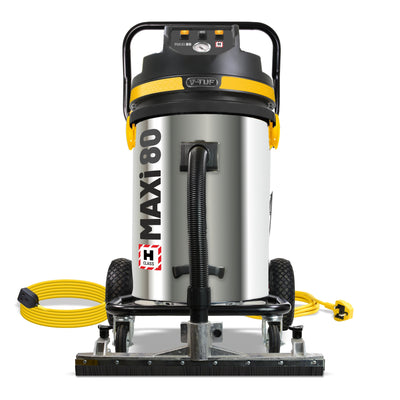
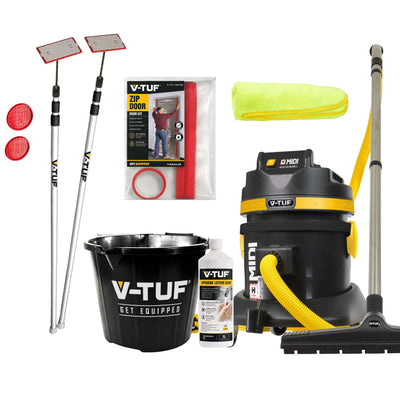
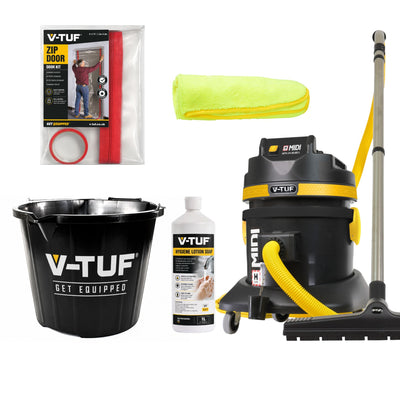
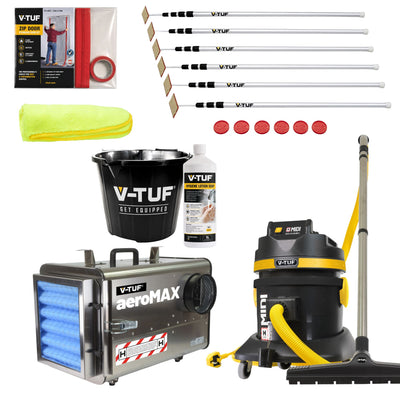
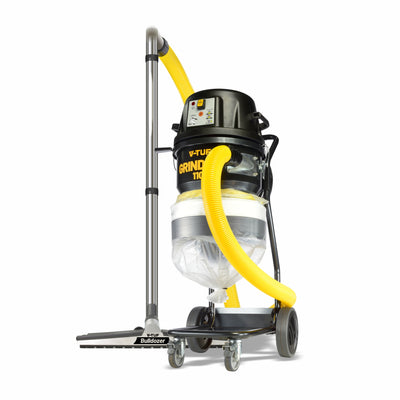
H-Class Health Rated Vacuum Cleaners
H-Class Health Rated Vacuums — 99.995% H14 HEPA for the Highest Hazard Applications
H-Class is the highest dust extraction classification under EN 60335-2-69. H14 HEPA filtration at 99.995% captures asbestos fibres, mould spores and the finest carcinogenic dusts that M-Class machines pass through their filters and exhaust back into the environment. For asbestos work, mould remediation and any application where M-Class is insufficient, H-Class is the only compliant specification.
Mould is a Hazard Group 2 biological agent under COSHH 2002 — H-Class is the required engineering control for any vacuuming of mould-affected surfaces. Under Awaab's Law, housing associations must ensure contractors use compliant equipment. H-Class is that equipment.
What is an H-Class vacuum?
An H-Class vacuum is independently tested and certified to capture at least 99.995% of fine particles at 0.3 microns. It is the class to use when the dust is hazardous to health and M-Class is not sufficient — carcinogenic dusts, mould spores, bacteria and other biological or chemical hazards. It is the class required for asbestos work under licensed contractor conditions.
The classification must appear on the machine itself — tested as a complete unit including seals, hose connections and dust disposal method, not just the filter in isolation.
Where H-Class vacuums are used
- Hospital and care-home refurbishment where ICRA infection control rules apply
- Mould remediation in social housing under Awaab's Law — H-Class is the COSHH engineering control
- Asbestos removal — licensed contractor specification
- Spray painting areas and isocyanate or composite dust
- Cleanrooms and fine-dust manufacturing environments
- Any environment where risk assessment requires H-Class
H-Class, M-Class or L-Class — which do you need?
Choose the class from the dust, not from the job title.
| Class | Min. Filtration | Dust it covers | Typical use |
|---|---|---|---|
| L-Class | 99% | WEL above 1mg/m³ | General workshop and site cleaning |
| M-Class | 99.9% | WEL 0.1mg/m³ or above — silica, hardwood, flour | Construction dust, tool extraction, stone cutting |
| H-Class | 99.995% | All dusts including carcinogenic and biological | Healthcare, mould, asbestos, hazardous dust |
Class definitions per EN 60335-2-69. Confirm against your COSHH risk assessment.
What to look for when choosing
- Wet and dry or dry only — wet and dry machines handle spills and slurry as well as dust. Dry-only models are lighter if you never meet liquid.
- Voltage — 110V for construction sites. 240V for workshops, hospitals and housing.
- Sealed disposal — Longopac sealed continuous bagging eliminates filter exposure during emptying. The most common route to H-Class compliance failure is the emptying process.
- Filter care — H14 HEPA filters must be replaced to the manufacturer's schedule. A damaged or saturated filter compromises the classification.
- Size and weight — compact machines for stairs and loft access. Larger tanks for long shifts and sustained remediation.
- Certification — ask for the test certificate showing the class was tested on the whole machine as a unit.
Frequently asked questions
What is the difference between M-Class and H-Class?
H-Class captures at least 99.995% of fine particles and covers hazardous dusts including carcinogens and biological hazards such as mould. M-Class captures at least 99.9% and covers most construction dust. Choose by the dust named in your COSHH risk assessment.
Do I need H-Class for mould removal?
Yes. Mould is classified as a Hazard Group 2 biological agent under COSHH 2002. H-Class is the required engineering control for any vacuuming of mould-affected surfaces. M-Class passes mould spores through its filter. Under Awaab's Law, social housing contractors must use compliant equipment. Mould removal standards and UKCMS →
Can I use an H-Class vacuum for asbestos?
Asbestos work is licensed and has its own HSE requirements. H-Class Type H is the vacuum specification for licensed asbestos removal, but follow HSE guidance and your licence conditions. Do not rely on this page alone for asbestos compliance.
Should I buy 110V or 240V?
Choose 110V for construction sites where reduced voltage is mandated. Choose 240V for workshops, hospitals and housing. A 240V machine on a step-up transformer is generally not accepted as site-safe.
Can an H-Class vacuum pick up water?
Only wet and dry models. Check the product page before using any machine on liquid — dry-only H-Class machines must not be used on wet waste.
How often should I change the H-Class filter?
Follow the manufacturer's schedule and replace sooner if suction drops or the filter is visibly damaged. On sustained remediation work, filter condition should be checked at each shift. Genuine V-TUF filters are available for all models — see vacuum spares →
Related: H-Class 240V → | H-Class 110V → | IAQ 2027 collection → | H-Class hub → | COSHH Regulations → | Awaab's Law →
Telephone: 01522 787978 for H-Class specification advice. Contact the V-TUF trade team →