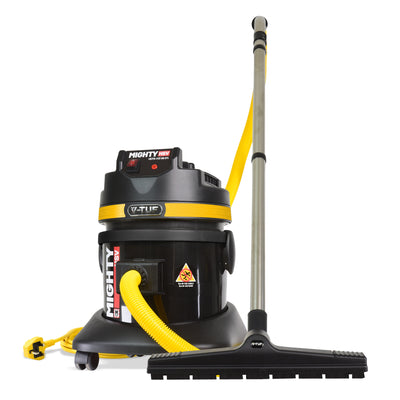
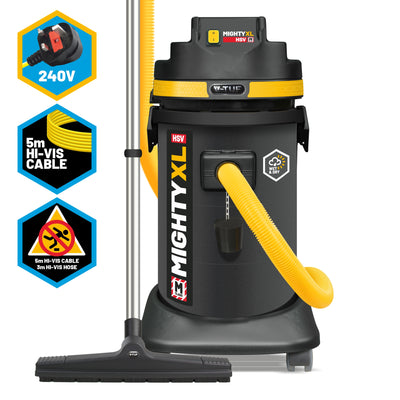
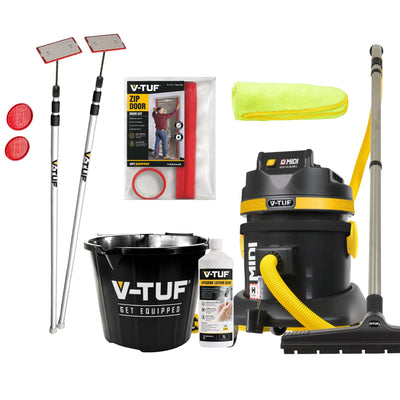
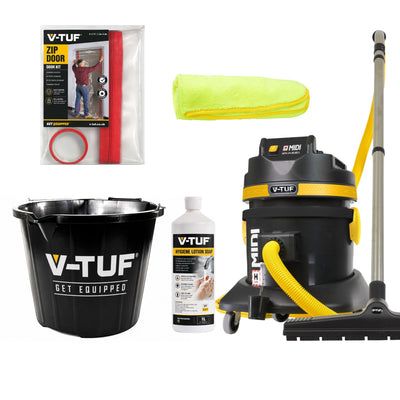
dry health rated vacuums
M-Class Health Rated Vacuum Cleaners — The Classification Mark Is the Compliance Evidence
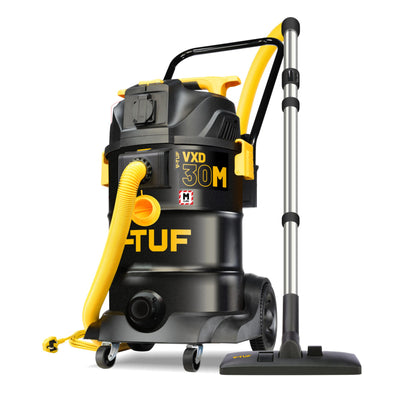
An M-Class vacuum cleaner is independently tested and certified to capture at least 99.9% of fine particles at 1 micron — the minimum standard required by COSHH 2002 for most construction dust. The classification mark on the machine is the evidence that satisfies a COSHH assessment, a method statement and an HSE inspector. A vacuum without an M-Class mark is not a compliant engineering control for hazardous dust, regardless of what its marketing literature claims.
Under COSHH 2002, employers must control worker exposure to hazardous dust through engineering controls before relying on RPE. For stone cutting, hardwood sanding and general construction dust, that engineering control is M-Class certified extraction connected directly to the tool or applied correctly to the surface.
What is an M-Class vacuum?
M-Class (Medium hazard) is the classification under EN 60335-2-69 for dust extractors capturing at least 99.9% of particles at 1 micron. It is the minimum class for most construction dust, including silica from cutting and drilling concrete, brick and stone. If you connect a vacuum to a power tool to control dust at source — on-tool extraction — M-Class is the standard most UK sites require and HSE enforces.
M-Class covers dusts with a Workplace Exposure Limit of 0.1mg/m³ or above. For dusts that are carcinogenic or biological — mould, asbestos, isocyanates — step up to H-Class.
M-Class, H-Class or L-Class — which do you need?
| Class | Min. Filtration | Dust it covers | Typical use |
|---|---|---|---|
| L-Class | 99% | WEL above 1mg/m³ | General workshop and site cleaning |
| M-Class | 99.9% | WEL 0.1mg/m³ or above — silica, hardwood, flour | Construction dust, tool extraction, stone cutting |
| H-Class | 99.995% | All dusts including carcinogenic and biological | Healthcare, mould, asbestos, hazardous dust |
Class definitions per EN 60335-2-69. Confirm against your COSHH risk assessment.
110V or 240V M-Class vacuum?
110V is the standard on UK construction sites — mandated by most principal contractors as a site electrical safety requirement and required for use with 110V power tools. 240V suits workshops, healthcare and housing where a standard socket is available. If you work across both environments, choose a model available in both voltages — the MINI HSV X2 and MIGHTY HSV are both available in 110V and 240V.
A 240V machine used on a 110V site via a step-up transformer is generally not accepted as site-safe. The machine must be natively rated for the voltage.
Using an M-Class vacuum with power tools
- Connect it to the tool — use the tool's dust port or shroud. A vacuum held nearby without a direct tool connection does not satisfy COSHH on-tool extraction requirements.
- Power tool take-off (PTO) — the vacuum starts automatically when the tool starts. The operative cannot forget to switch it on. See the PTO dust extractor range →
- Match airflow to the tool — angle grinders and wall chasers need higher airflow than drills. Check the machine's airflow figure against the tool manufacturer's recommendation.
- Filter cleaning — on long jobs, automatic or manual filter shaking maintains suction. A clogged filter reduces capture and can take the machine below its rated classification.
- Use bags — sealed dust bags prevent re-exposure when emptying. Do not tip loose dust.
Quick buying checklist
- Name the dust from your COSHH risk assessment
- Confirm the class required — L, M or H
- Choose the voltage for where you work — 110V site or 240V workshop
- Match airflow and tank size to your tools and shift length
- Check filter and bag availability for ongoing servicing
- Ask for the certification showing the class was tested on the complete machine
Frequently asked questions
Is an M-Class vacuum enough for silica dust?
M-Class is the minimum most UK sites accept for silica from cutting and drilling, used with tool-mounted on-tool extraction. HSE conducted over 1,000 site inspections in 2026 specifically targeting RCS exposure. Your COSHH risk assessment sets the requirement. HSE silica crackdown 2026 →
What is the difference between M-Class and H-Class?
M-Class captures at least 99.9% of fine particles and covers most construction dust. H-Class captures at least 99.995% and covers hazardous dusts including carcinogens and biological hazards such as mould. Choose by the dust named in your risk assessment. When in doubt, step up — H-Class is never wrong, only more expensive.
Do I need H-Class for mould removal?
Yes. Mould is a Hazard Group 2 biological agent under COSHH 2002. H-Class is the required engineering control for mould remediation vacuuming. M-Class passes mould spores through its filter. H-Class vacuum range → | Awaab's Law →
Should I buy 110V or 240V?
110V for construction sites, 240V for workshops and healthcare. If you work in both, choose a model available in both voltages — the MINI HSV X2 and MIGHTY HSV both come in 110V and 240V.
Can an M-Class vacuum pick up water?
Only wet and dry rated models. Check the product page before using on liquid — dry-only machines must not be used on wet waste.
How often should I change the filter?
Follow the manufacturer's schedule. Replace sooner if suction drops or the filter is damaged. Genuine V-TUF replacement filters are available for all models. Vacuum spares →
Related: M-Class 240V → | M-Class 110V → | M-Class battery → | PTO extractors → | M-Class hub → | COSHH Regulations → | HSE silica crackdown 2026 →
Telephone: 01522 787978 for M-Class specification advice. Contact the V-TUF trade team →